
Most of us have taken a personality test at some point. These tools tell you you’re a “blue” or a “yellow,” a Type 3, an introvert, or an INFJ. And there’s something satisfying about that. We got a neat label. A moment of recognition. The feeling of “Oh yes, that sounds like me.”
These tools are useful. They give us language, validation, sometimes even relief. By offering us a stereotype we can identify with, they bring awareness to our actions and allow us to ask ourselves insightful questions. However I’ve noticed these tests all have a common denominator: they focus on who we are, not how we think.
And how we think is a different layer altogether.
It’s what shapes the way we solve problems, the way we handle pressure, the way we collaborate, or clash, with others. It’s what influences the questions we ask, the things we prioritise, what we notice, and what we miss. In other words, it quietly determines how we lead, long before we open our mouth.
I remember working with a leadership team that ticked all the boxes on paper: strong experience, shared values, alignment on business goals. But in the room, something felt flat. Discussions moved fast, but without much depth.
Strategic blind spots weren’t being raised.
One person, quiet, thoughtful, the only one asking long-term questions, had stopped contributing. She wasn’t disengaged. She just couldn’t keep up with the pace of conversation. By the time she was ready to speak, the group had already moved on.
It wasn’t a culture problem. It was a thinking problem. More precisely, it was a lack of thinking diversity.
We often talk about psychological safety and rightly so. It’s the foundation for open conversations. But even when people feel safe to speak, what really matters next is: What perspectives are actually in the room? What kinds of thinking are being expressed? And which ones are being drowned out not by politics or power plays, but simply by pace, preference, or habit?
When everyone shares the same decision-making defaults, even high-performing teams can miss crucial insights.
In the case of my leadership team, they move quickly, but narrowly. Important ideas get left unsaid not out of fear, but because they simply don’t fit the dominant way of thinking in the room. This is why understanding how we think matters not just for self-awareness, but for team dynamics, decision quality, and long-term resilience.
That’s the thinking behind the tool I’ve built: the Thinker Test.
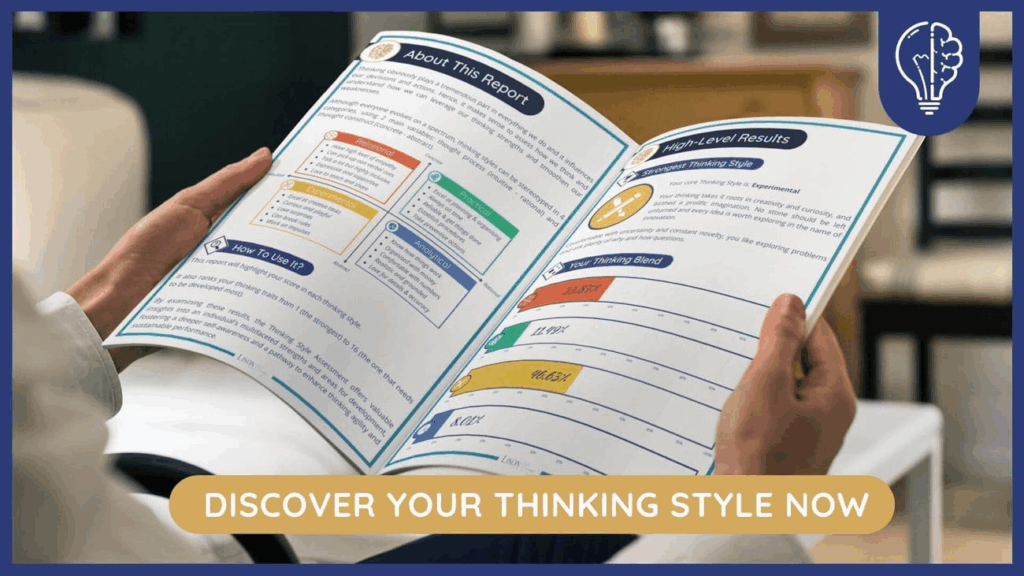
It’s not a personality quiz but a thinking one. Instead, it looks at 16 core cognitive capacities from curiosity, logic and imagination to resilience, emotional clarity and perspective-taking. It helps you notice your own thinking patterns: the ones you lean on, and the ones you may be underusing without realising.
Because most of us lead from habit. We trust what’s worked before. But as complexity increases, that narrow lane can become a blind spot.
This isn’t about changing who you are. It’s about widening your cognitive range.
Having more tools available. Being more intentional. Especially if you lead others, shape strategy, or want to build a team that genuinely thinks better together.
If you’d like to explore your own thinking profile, the test takes less than ten minutes. It’s designed to give you clarity and language not to box you in, but to open things up.

What I’ve seen is that when people understand how they think, everything else becomes easier.
Communication. Collaboration. And most importantly, the ability to pause and choose not just react.
And in leadership, that makes all the difference.
Speak soon,
Lison
PS: If someone has forwarded this to you, you can subscribe here. It’s free. Your information is protected. And I never spam. Ever.
Whenever you are ready, here are a few ways I can help:
With my first book Act Before You overThink to learn how to make better decisions faster and liberate your mind from the constant chatter that hinders your potential. You can buy it here.
Discover the secrets to skyrocketing your team’s performance in my free Masterclass! Join me on the 8th of December to talk high-performance strategies and walk away with actionable tools to inspire and empower your team. Register here.
Join my 1-1 coaching program designed to elevate your performance, leadership, and positioning. Whether you’re looking to gain clarity, strengthen your leadership presence, or take your career to the next level, I’ll help you achieve tangible results. Book a call to explore how we can work together here.
Book one of my workshops or keynotes for your team to elevate energy and performance. More information here.

Responses